Canada's own AI fusion system for maritime domain awareness. Detection is solved; deciding what matters is not. Erebus sits above the sensors, ranks the contacts that need a decision, explains each call against its evidence, and points the low-cost drone sent to verify. Built to run on your own infrastructure.
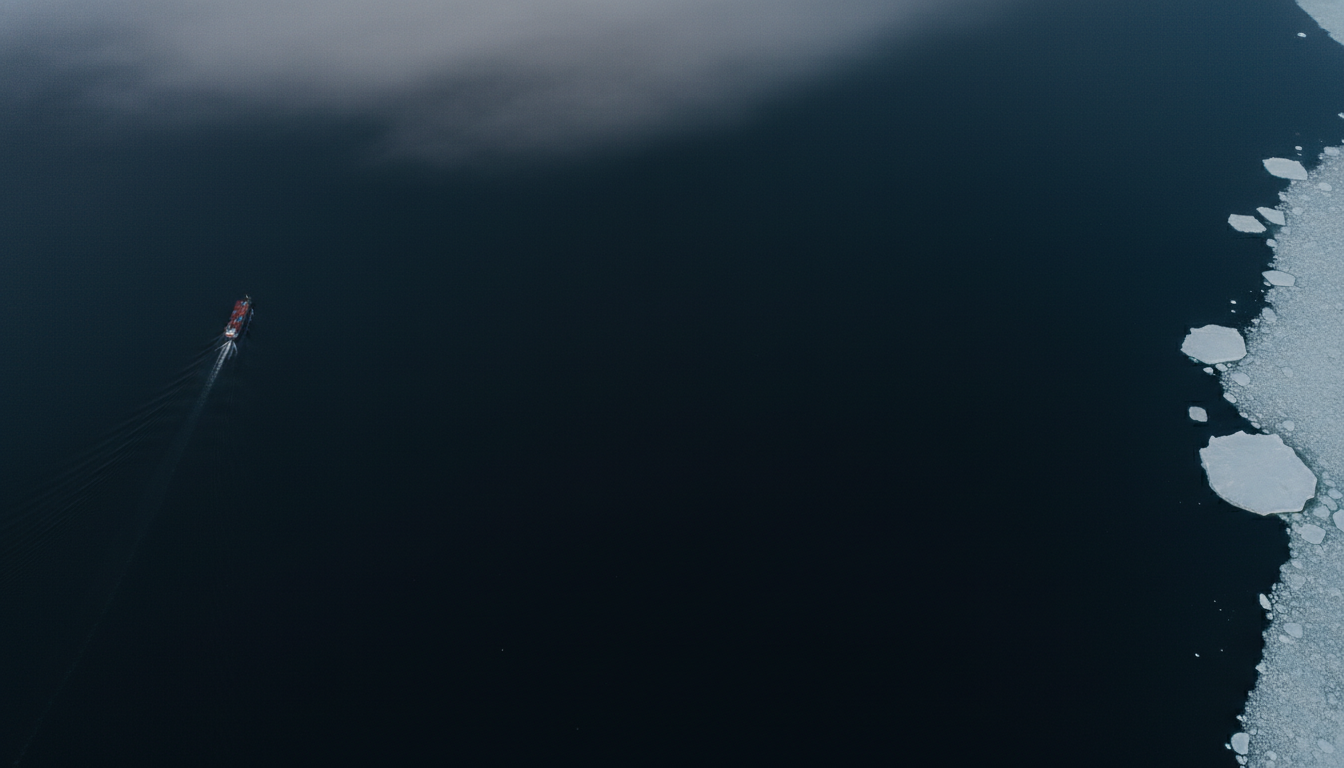
Canada owns the longest coastline on earth and an Arctic that is opening fast, watched by a handful of satellites and ships. Any vessel can switch off its AIS and vanish, and that is how sanctions get evaded, fish get stolen, and contested waters get tested. Global Fishing Watch and Windward put 5 to 10 percent of global traffic dark at any time. Peer-reviewed analysis (Nicoll et al., Maritime Transport Research, January 2025; Transport Canada and University of Ottawa) measured that the main free Arctic AIS dataset caught only 11 percent of Canadian Arctic vessels in 2013 and 65 percent by 2020, structurally biased to Norway and Iceland where terrestrial receivers exist.
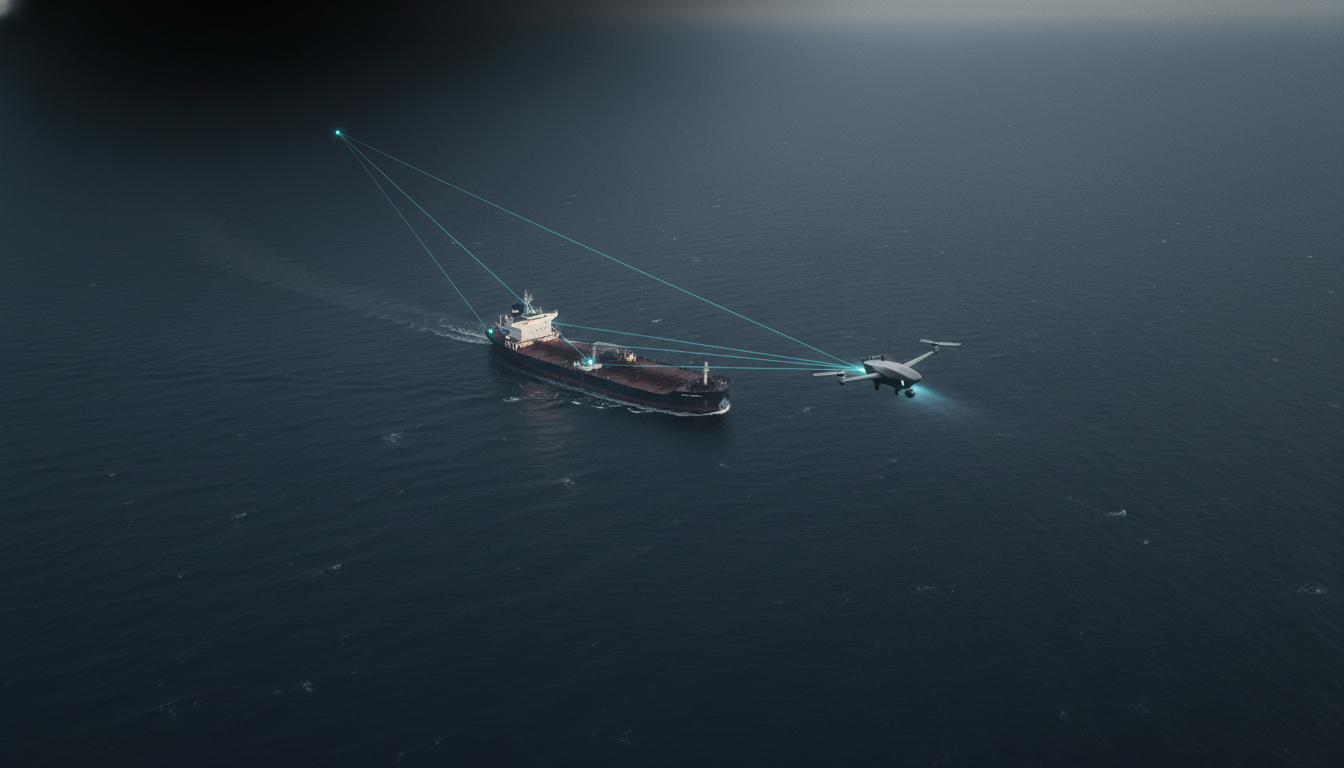
Erebus closes a single loop: watch wide from space, decide with a sovereign AI brain, verify with low-cost drones.
The challenge asks for an AI that fuses at least two kinds of data. Erebus fuses three, satellite imagery, RF, and telemetry, by place and time. Detection is largely solved and fielded; what the sensors leave to human analysts is the deciding. Erebus is that layer, above the sensors, not another one. Demonstrated end-to-end on operational data; the work being funded is Arctic-specific calibration so it runs the same way over the Northwest Passage.
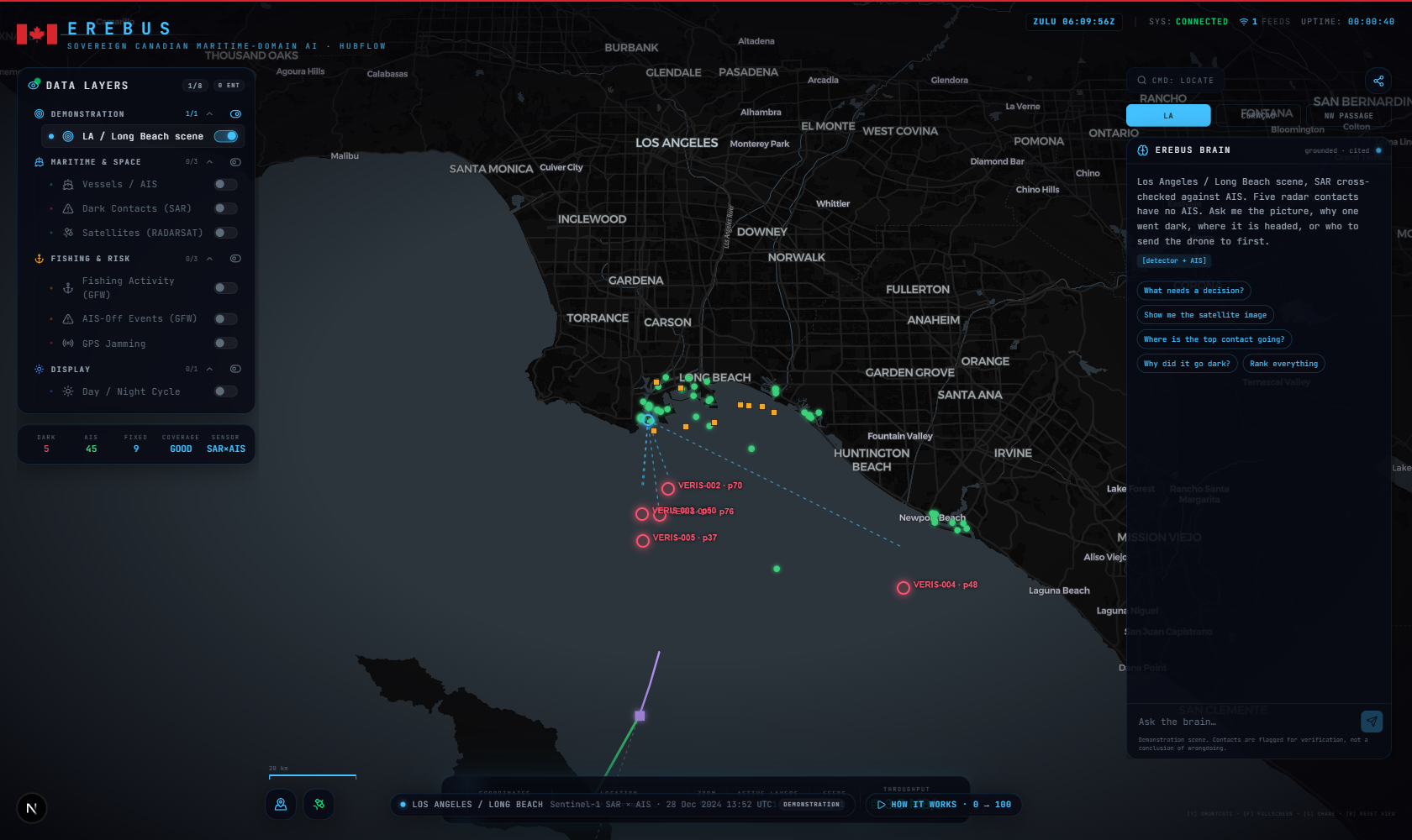
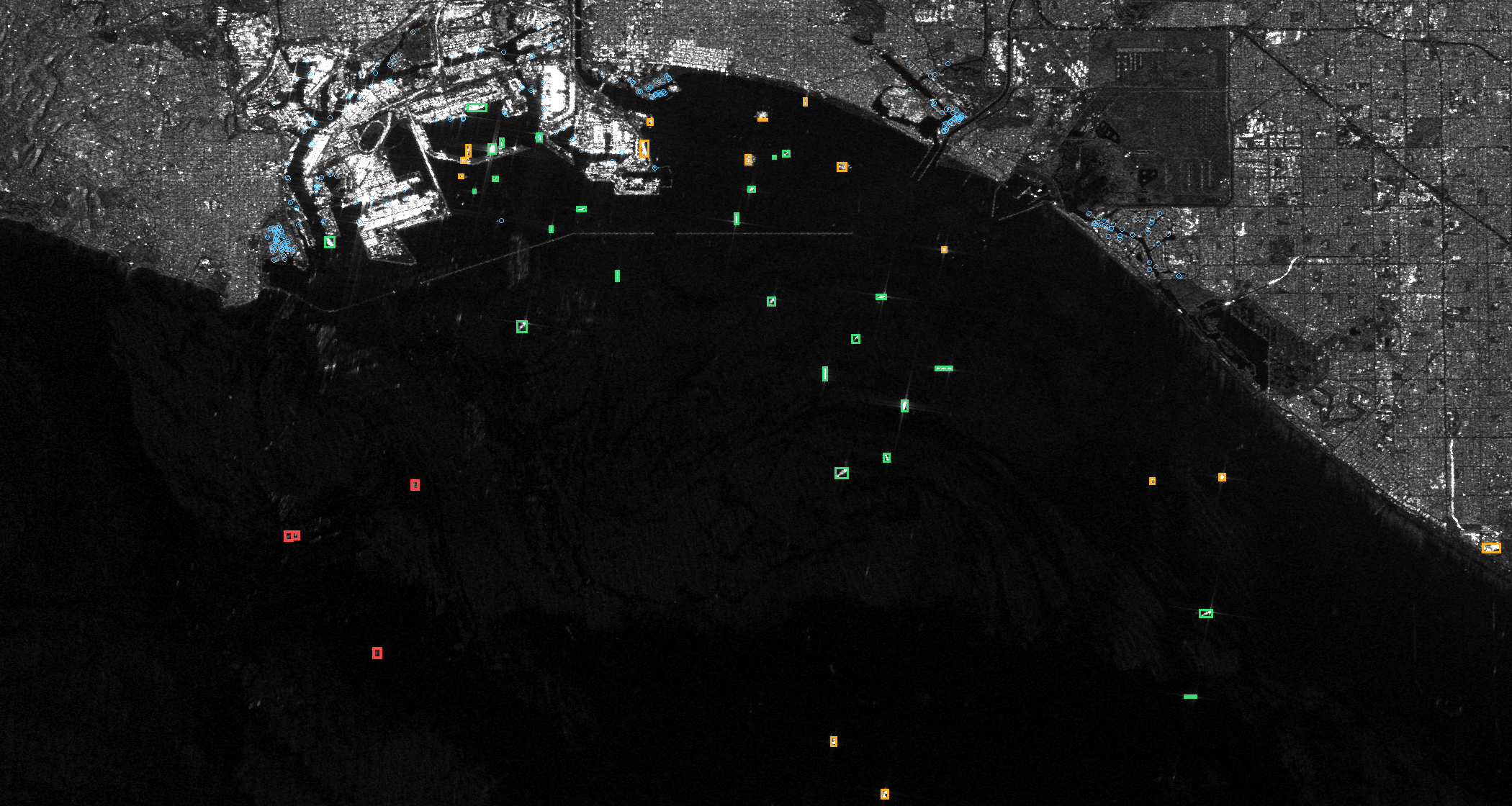
Detects every ship in satellite radar and checks each one against AIS. The contacts with no matching signal are the vessels that went dark to disappear.
The AI brain ranks which contacts matter, reasons why a vessel went dark, cites the evidence, and calibrates confidence against how complete coverage is there, so a reception gap is not mistaken for a dark vessel. The operator gets a call they can act on and defend.
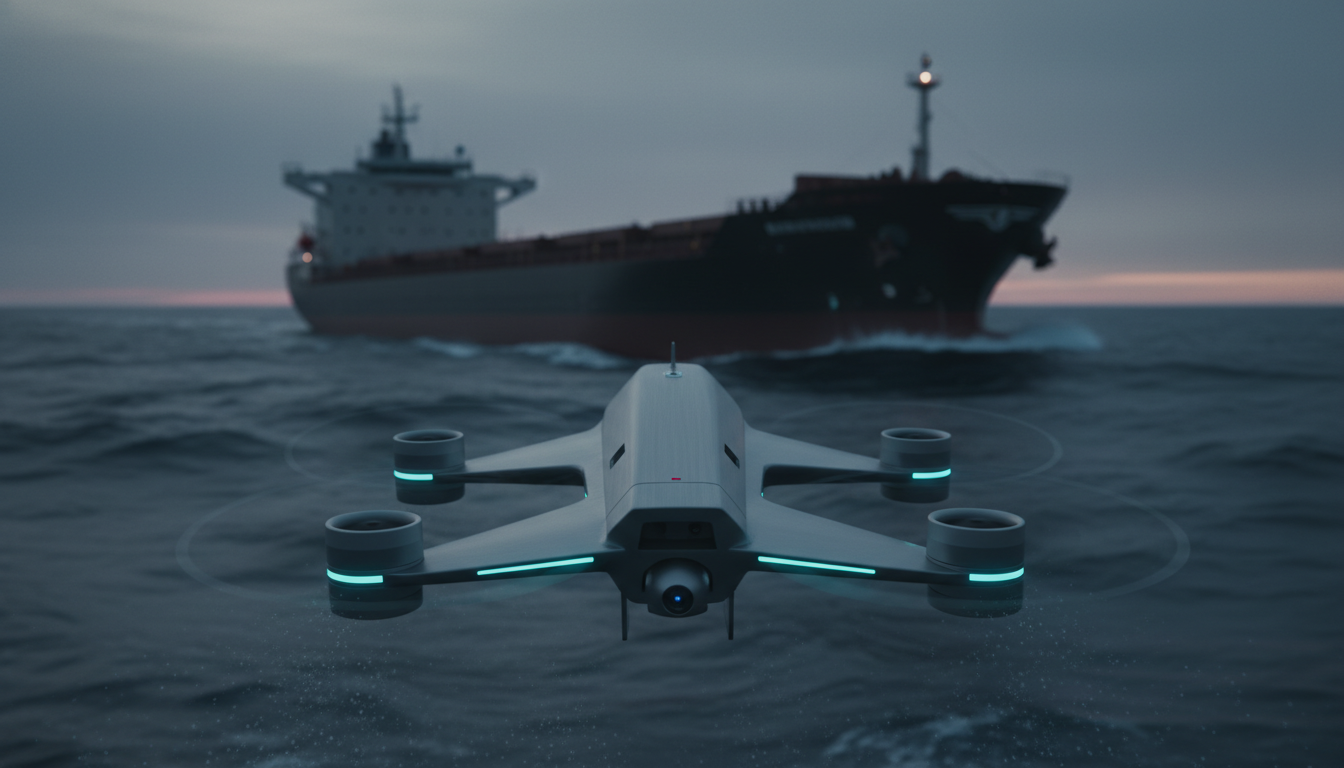
Turns the flag into exact coordinates and a forecast position, then cues a low-cost autonomous drone to confirm, keeping scarce crewed aircraft for real escalation.
Hiding is rarely one trick. Erebus is built around the deceptive-shipping playbook that sanctions evaders, illegal fishers, and grey-zone actors actually use.
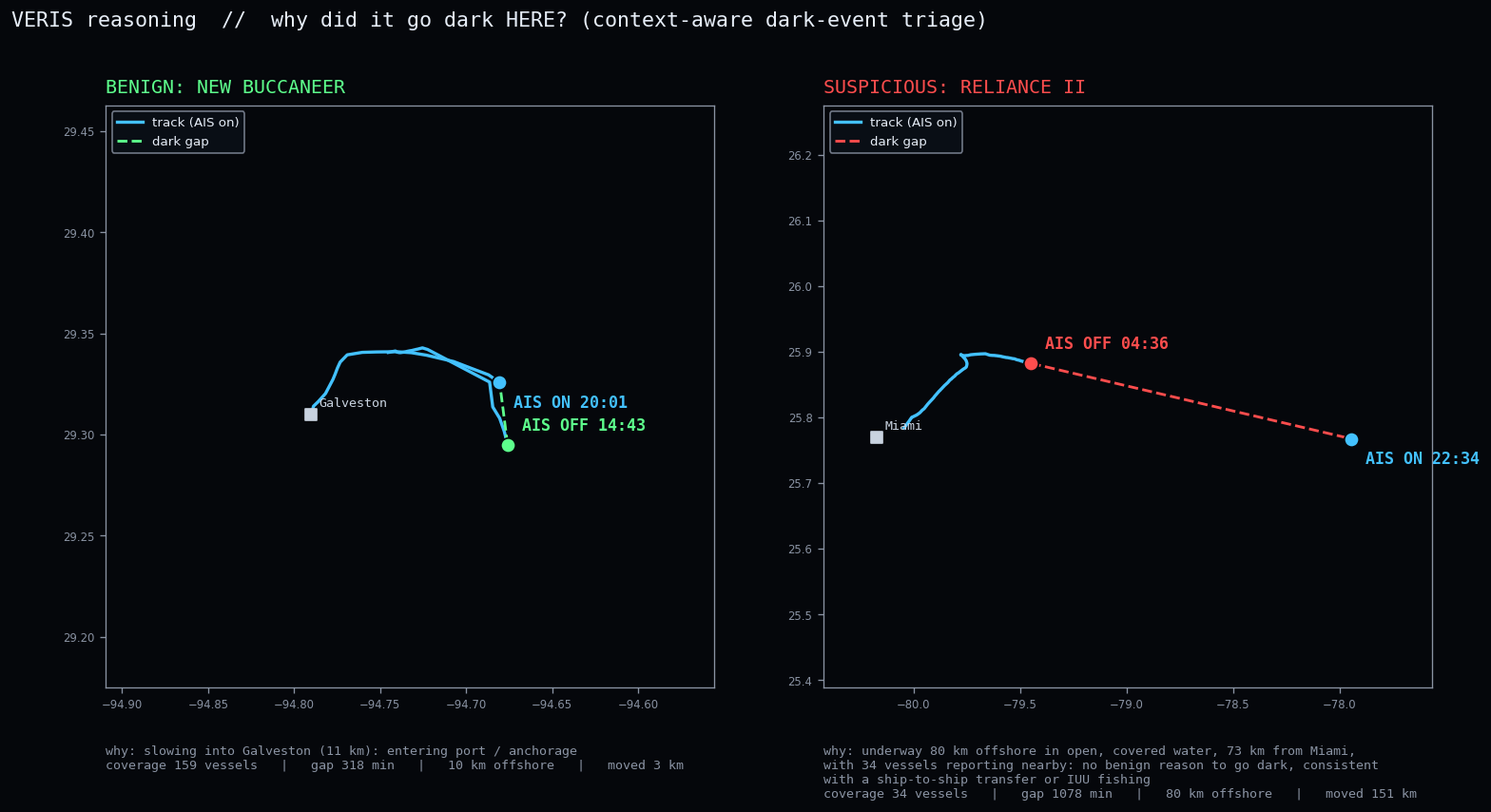
AIS switched off in open water, with no port call or coverage gap to explain it.
Name, MMSI, or flag swapped while the permanent IMO stays the same. The classic shadow-fleet move.
Peer-reviewed analysis (Nicoll et al. 2025) measured 2.8 percent of Arctic AIS tracklines spoofed, with structured Kara Sea star patterns and Arctic-Circle-to-Norway lines consistent with sanctions-evasion routing. Erebus detects the geometry.
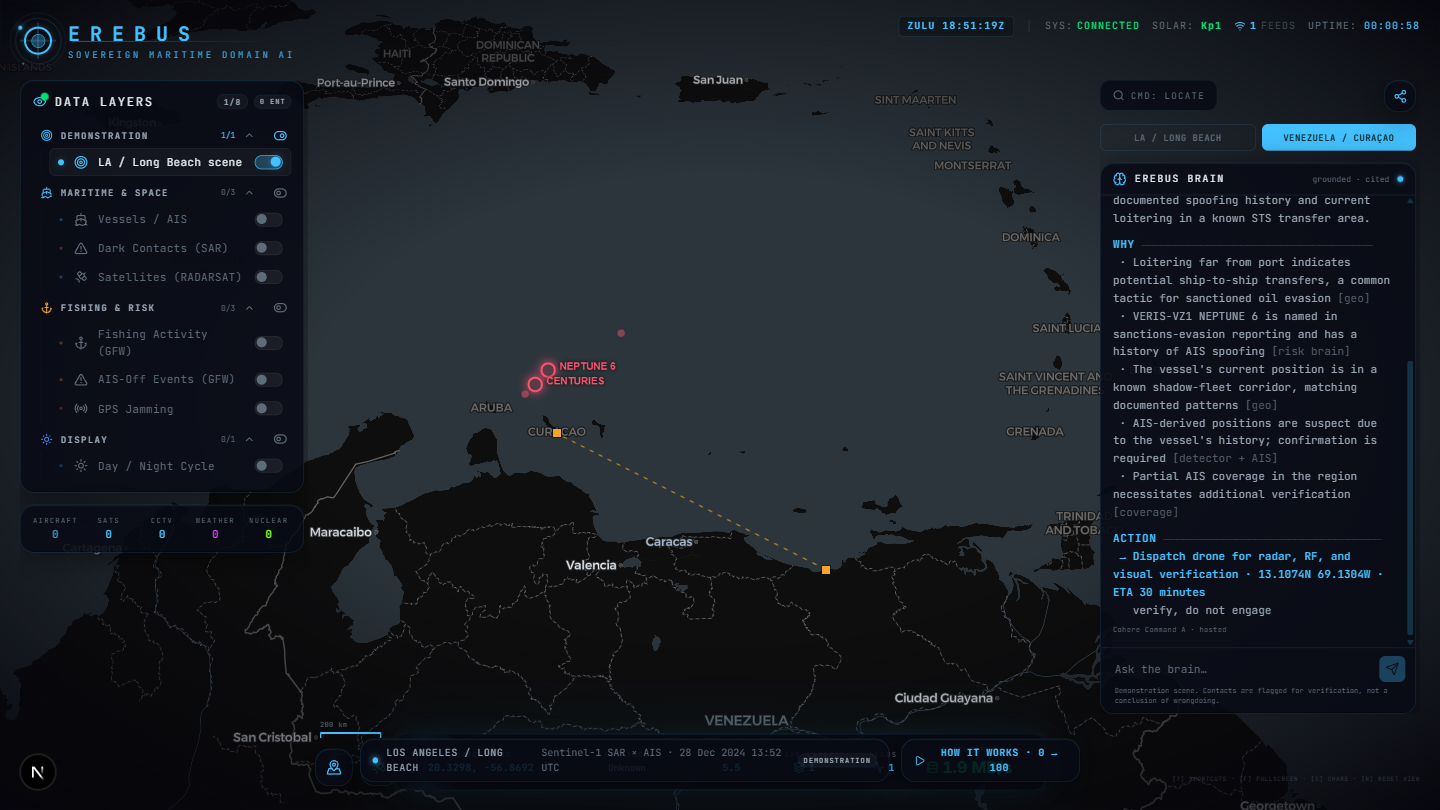
Two vessels meeting and loitering offshore, the signature of an illicit ship-to-ship transfer.
A radar contact with no matching AIS. Unknown, worth a closer look. Distinguishing a never-cooperative hull from a transient gap is the longitudinal memory the funded build adds.
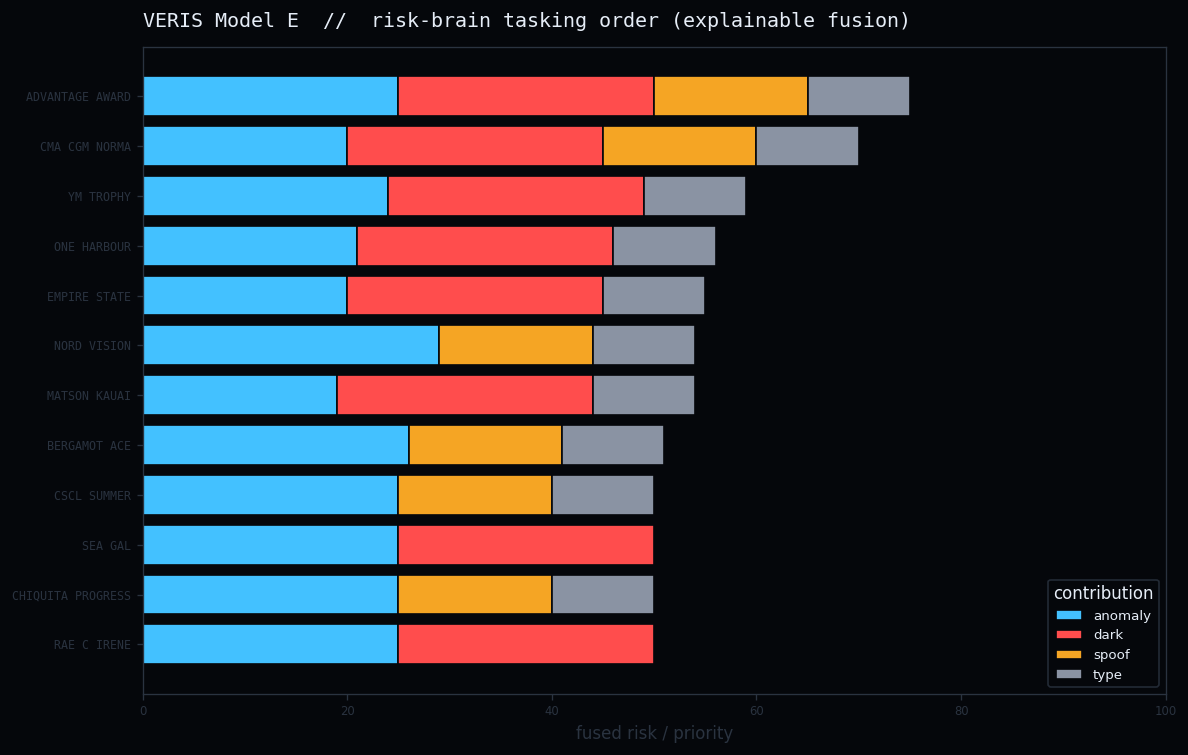
Five models feed one AI brain. They work together, then an LLM-based decision layer turns their signals into a documented assessment that shows the supporting evidence and how certain the system is.
finds ships in radar (91%)
types a vessel from radar alone (in build)
flags dark/identity, reasons why
predicts the intercept point
fuses all into one priority
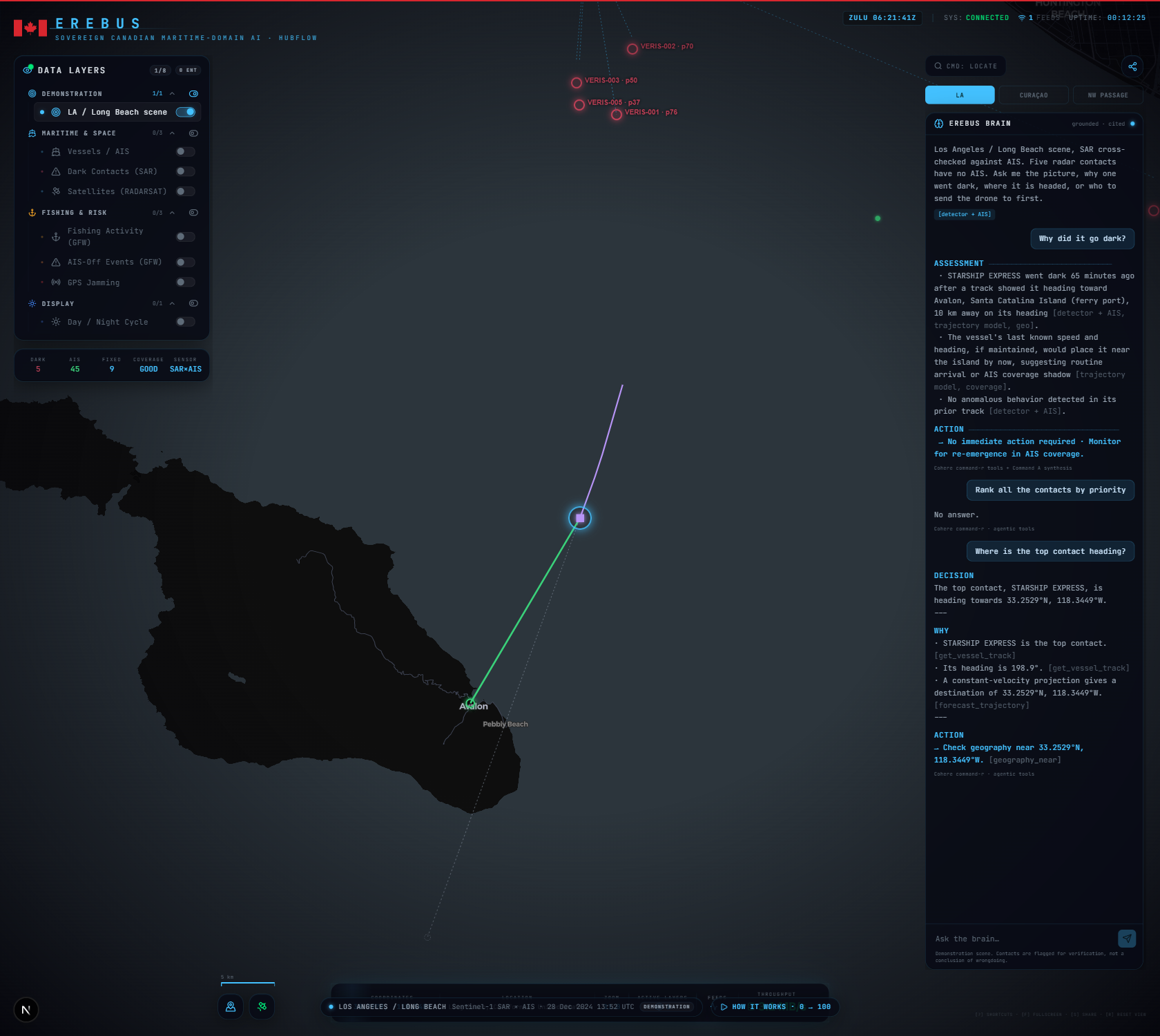
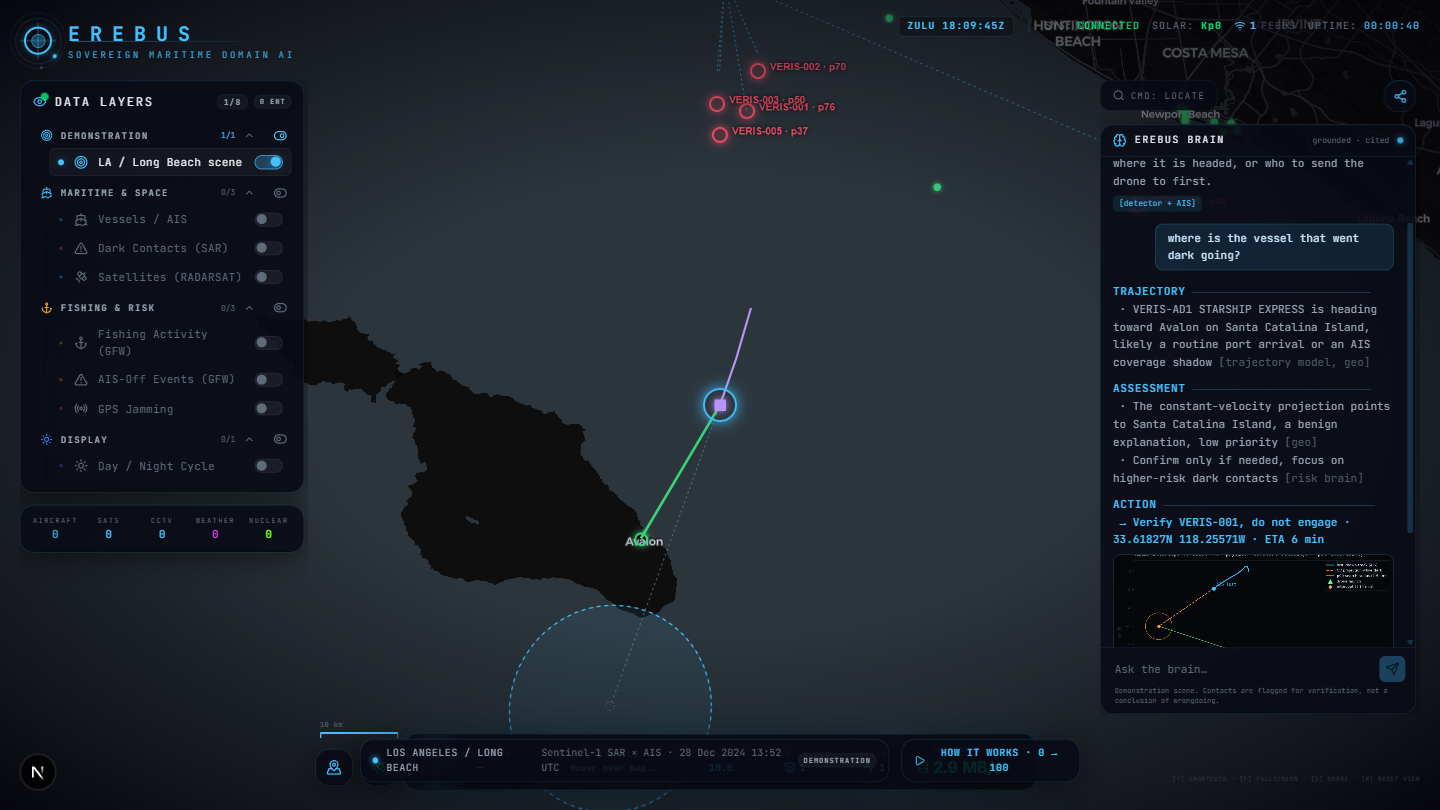
· STARSHIP EXPRESS went dark 65 minutes ago after a track showed it heading toward Avalon, Santa Catalina Island (ferry port), 10 km away on its heading [detector + AIS, trajectory model, geo].
· Last known speed and heading, if maintained, would place it near the island by now, suggesting routine arrival or AIS coverage shadow [trajectory model, coverage].
· No anomalous behavior detected in its prior track [detector + AIS].
→ No immediate action required · Monitor for re-emergence in AIS coverage.
Erebus is a proprietary system. It orchestrates a swappable language model, a sovereign Canadian open model (Cohere Command A+, Apache 2.0) self-hostable on-premise for classified use; the engine, models, grounding, and calibration are Hubflow IP.
Built and run on real, time-stamped satellite and AIS data, the same day, the same minute. These outputs come from the working system.
ships in satellite radar (validation mAP50 0.91), on held-out data
vessels confirmed against AIS; fixed structures correctly set aside (LA / Long Beach, 28 Dec 2024)
AMIS WISDOM II silent underway, 305 km covered (17.8 kt avg, up from 11.7 kt before), 23 vessels reporting nearby; plus identity-change resolved by IMO
ships the open AIS feed showed over the Northwest Passage, measured first-hand
uncalibrated detector produces ~50 false positives per scene window on Arctic ice (snow ridges, ice crevasses mimic ship returns); M2 funded work targets <5


By rejecting fixed structures before raising a cue and treating missing AIS as a candidate to verify, Erebus reduces false alerts versus a naive radar-minus-AIS approach, so scarce patrol hours go to genuinely suspicious contacts.
Hubflow has delivered for government before: a domain-specialized translation engine a Canadian federal agency evaluated at roughly twice a general-purpose baseline.
An operator asks in plain language; the brain works the scene itself, grounds and cites every claim, calibrates against coverage, and cues a drone. It is never told which contact matters; it determines that from the evidence, the call a trained analyst would make, in seconds, with its reasoning recorded. The proof that it judges rather than alarms: it reads two real scenes in opposite directions.


The same brain carries to the Arctic: over the Northwest Passage, where the open AIS feed shows nothing, it treats a radar contact with no AIS in Canada's sovereign Lancaster Sound as a candidate unauthorized transit to verify, the Arctic case this challenge targets.
Most contacts are routine. The funded build adds vessel and regional memory so an operator can pre-clear the ships that belong and pre-flag the ones that do not. One piece, identity tracking across renames by permanent IMO, is already demonstrated; the rest is what Component 1a builds on top of it.
Funded build. Known-good vessels recognised and set aside before they ever raise an alert, on top of the demonstrated identity-by-IMO and coverage-calibration steps.
Funded build. Known-bad vessels auto-escalated the moment they appear, tracked by permanent IMO (demonstrated) so a rename will not shake them. The lists and feed integrations are the work this component delivers.
A satellite can see a dark ship but it cannot go look. A crewed patrol can look but cannot be everywhere. Erebus joins the two: it finds the contact, decides it is worth a look, and produces a precise tasking for a low-cost drone to verify.
Canadian-built and Canadian-owned, on a Canadian open model (Cohere Command A on-prem; Command A+ on customer hardware, Apache 2.0). The decision layer stays in Canada, not a foreign cloud or vendor. Estimated ~80 percent Canadian content across labour, equipment lease, cloud compute, and the MDA RADARSAT-2 archive line.
Built to run on the customer's own infrastructure, so classified data never leaves it.
Every output cites its evidence, carries a confidence, and leaves an audit trail an operator can defend.
Demonstrated on Sentinel-1 and AIS; commercial-Arctic stack adds Kpler S-AIS, Unseenlabs RF emitter geolocation, MDA RADARSAT-2 (Canadian SAR), IHS registry, plus free VIIRS DNB nightlight. Radar generates its own signal, so detection keeps working under active GPS jamming in Arctic exercise areas (Boulègue 2019, Chatham House).